🇬🇧 UK News 📍 London ⚠️ 16 May 2026 Massive Protests in London — What You Need to Know Two enormous demonstrations are taking over central London on 16 May 2026 — here is what is happening, who is marching, and what it means if you are travelling into the city ⚠️ 4,000 police officers ... Massive Protests in London — What You Need to Know
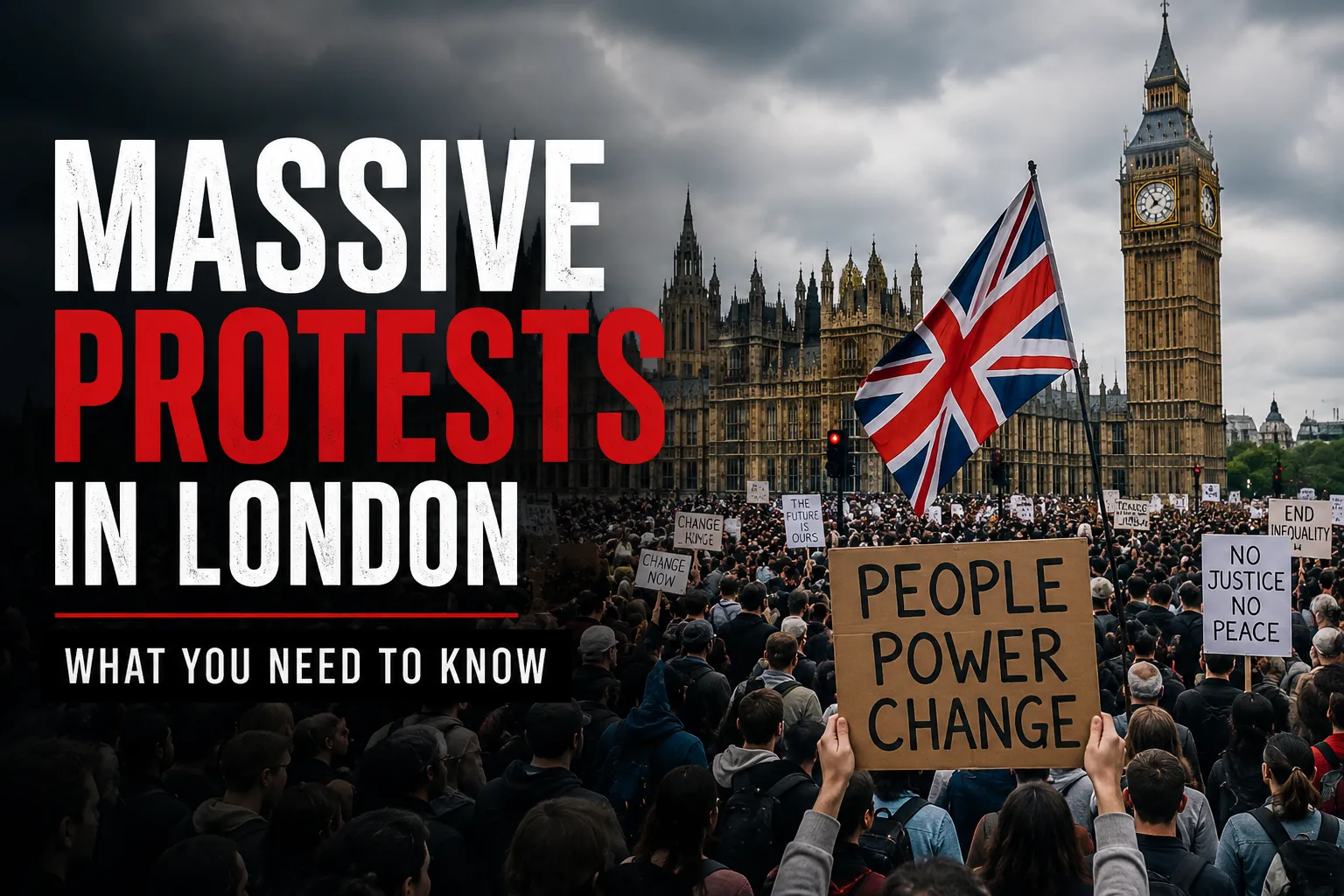
Two enormous demonstrations are taking over central London on 16 May 2026 — here is what is happening, who is marching, and what it means if you are travelling into the city
4,000 police officers are being deployed across central London on 16 May 2026 — the Met Police has called it potentially one of the busiest days for policing London has seen in years. Major road closures and travel disruption are expected across Westminster all day.
On Saturday 16 May 2026, central London will see two of the largest political demonstrations it has witnessed in years — happening on the same day, in the same city, with strict police conditions keeping them apart. If you are in London, travelling through London, or simply trying to understand what is going on — here is a clear, straightforward guide to what is happening and why.
Central London on 16 May is home to two major demonstrations that represent very different political movements. The Metropolitan Police has approved both, under strict conditions to keep the two groups apart.
Nakba Day March — 78th Anniversary
"Unite the Kingdom, Unite the West"
Exact Locations & Times for Both Protests
12:00pm – 6:00pm
Speeches end by 5:00pm
Exhibition Road
South Kensington, SW7 2DB
Exhibition Road → Brompton Road → Knightsbridge → Piccadilly → St James's Street → Pall Mall / Waterloo Place (final rally)
12:00pm onwards
Rally at Parliament Square
Kingsway
Central London, WC2B
Kingsway → Aldwych → Strand → Trafalgar Square → Whitehall → Parliament Square (stage & rally)
🚫 Streets to avoid on 16 May (10am–7pm): Kingsway · Aldwych · Strand · Trafalgar Square · Whitehall · Parliament Square · Exhibition Road · Brompton Road · Knightsbridge · Piccadilly · St James's Street · Pall Mall
The decision by the Metropolitan Police to approve both marches on the same day — and to give the far-right march access to Parliament Square and Whitehall while rerouting the pro-Palestine march away from its traditional route — has sparked significant political anger.
MPs tabled an Early Day Motion in Parliament accusing the Met of favouring Tommy Robinson's march, pointing out that previous pro-Palestine demonstrations have been considerably larger and consistently peaceful — while previous Unite the Kingdom marches have involved violence, attacks on police, and anti-Muslim chanting.
"It appears the Met has given over the political centre of London to a hate march, while denying the Palestine movement its formally requested route." — Palestine Coalition statement
The Met Police responded that its decisions are based on public order considerations and expected crowd sizes — not on the political views of the groups involved. Pro-Palestine march organisers eventually reached an agreement with police on an alternative route and confirmed the march will go ahead.
⚠️ Same day as the FA Cup Final at Wembley. 16 May 2026 is also the day of the FA Cup Final — meaning the Met Police is simultaneously managing three major events across London. Travel disruption across the entire city is expected to be severe throughout the day.
To understand why London is seeing two massive protests on the same weekend, it helps to understand the context that has built up over the past two years.
Fortnightly Pro-Palestine Marches
Since the outbreak of the conflict in Gaza in late 2023, the Palestine Solidarity Campaign and its partners have organised regular large-scale marches through central London. Crowds have regularly reached hundreds of thousands. The 2025 Nakba Day march drew an estimated 500,000 people.
First "Unite the Kingdom" March
Tommy Robinson's first "Unite the Kingdom" march drew between 110,000 and 150,000 people according to Met Police estimates. Tech billionaire Elon Musk addressed supporters via video link. Twenty-three participants were arrested. A counter-protest by Stand Up To Racism drew around 5,000.
UK Local Elections
Local elections took place just days before the protests, with Reform UK — a right-wing party — making significant gains. The political atmosphere around immigration and identity politics has intensified considerably as a result.
Half a Million March Against the Far Right
Just weeks before the May protests, at least 500,000 people took part in a march against the far right through central London — one of the largest political demonstrations the UK capital had seen in years. Trade unions organised a 15,000-strong bloc.
Both Marches — Same Day
The 78th anniversary of the Nakba falls on 15 May. The commemorative march in London is scheduled for 16 May — the same day Tommy Robinson's second "Unite the Kingdom" march has been approved. 4,000 police officers will be deployed to keep the two groups apart.
If you are planning to be in central London on 16 May 2026, you need to plan ahead carefully. Road closures and diversions are expected across Westminster, the Strand, Whitehall, Parliament Square, and surrounding areas throughout the day.
🚇 Use the Tube or bus where possible — driving in central London will be extremely difficult. Check tfl.gov.uk or follow @TfL on X for live updates throughout the day.
🚗 Avoid these areas entirely on 16 May: Kingsway, Aldwych, the Strand, Trafalgar Square, Whitehall, Parliament Square, Exhibition Road, Brompton Road, Knightsbridge, Piccadilly, St James's Street, and Pall Mall.
⏱️ Disruption expected from 10am to 7pm — allow significantly extra time for any journey in or around central London or Wembley (FA Cup Final).
🚁 Police resources deployed: 4,000 officers including 660 from other forces, helicopters, drones, dog units, police horses, armoured vehicles, and live facial recognition technology.
🏢 If you work in central London: Westminster City Council has advised businesses to check TfL updates and adjust delivery times where possible.
These Protests Are Directly Relevant to Anyone Who Has Moved to the UK
The politics surrounding these two marches — immigration, identity, Gaza, and the rise of the far right — are not abstract issues for migrants. They are part of the daily reality of living in Britain as a person from another country.
The growth of far-right movements in the UK, the recent gains by Reform UK in local elections, and the ongoing political debate around immigration policy all have direct implications for people on visas, those applying for ILR, and those building lives in Britain.
The Met Police is deploying 4,000 officers — including 660 from other forces — and has strict conditions in place to keep the two protests apart. If you are not attending either protest, the safest approach is to avoid the areas around the march routes (Whitehall, Parliament Square, Trafalgar Square, Knightsbridge, and Exhibition Road). Most of London will be completely unaffected.
The Nakba — the Arabic word for "catastrophe" — refers to the mass displacement of around 700,000 Palestinians during the 1948 conflict that led to the creation of the state of Israel. The 78th anniversary falls on 15 May 2026. Annual marches to commemorate it have grown significantly in size since the outbreak of the conflict in Gaza in 2023, with London's 2025 event drawing an estimated 500,000 people.
Tommy Robinson is the pseudonym of Stephen Yaxley-Lennon, a British far-right activist and co-founder of the English Defence League. His "Unite the Kingdom" rallies focus on opposition to immigration, Islam, and what he calls the "establishment." The previous rally in September 2025 drew between 110,000 and 150,000 people and involved both pro-Israel and anti-Muslim elements. Robinson has a significant following in the UK and has recently connected with far-right movements across Europe and the United States.
The Metropolitan Police has imposed strict conditions on both marches to keep them physically separated. Pro-Palestine marches have historically been peaceful — the violence at previous Unite the Kingdom events came from far-right participants. Police have a significant operation in place and the two routes have been deliberately designed to avoid contact. There is always an element of unpredictability with large protests, but the policing operation is substantial.
The political climate around immigration in the UK has shifted significantly in the past year. Reform UK's gains in the May 2026 local elections have put pressure on the government. While protests themselves do not change policy directly, they reflect and can intensify public and political debate around immigration, visas, and settlement rules. If you are concerned about how these changes might affect your own visa or immigration situation, speak to a qualified adviser.
Whatever your views on the politics involved, what is happening on 16 May 2026 reflects a Britain in the middle of a significant debate about identity, immigration, foreign policy, and what kind of country it wants to be. If you are a migrant in the UK, these conversations matter to you — and it is worth staying informed.
If you have questions about how the current political climate might affect your visa, your ILR application, or your long-term plans in the UK, our team is here to help you understand your options clearly and confidently.
The political landscape in the UK is changing. If you have questions about your visa, your ILR pathway, or your rights as a migrant — book a consultation with our expert team and get clear, reliable guidance.