

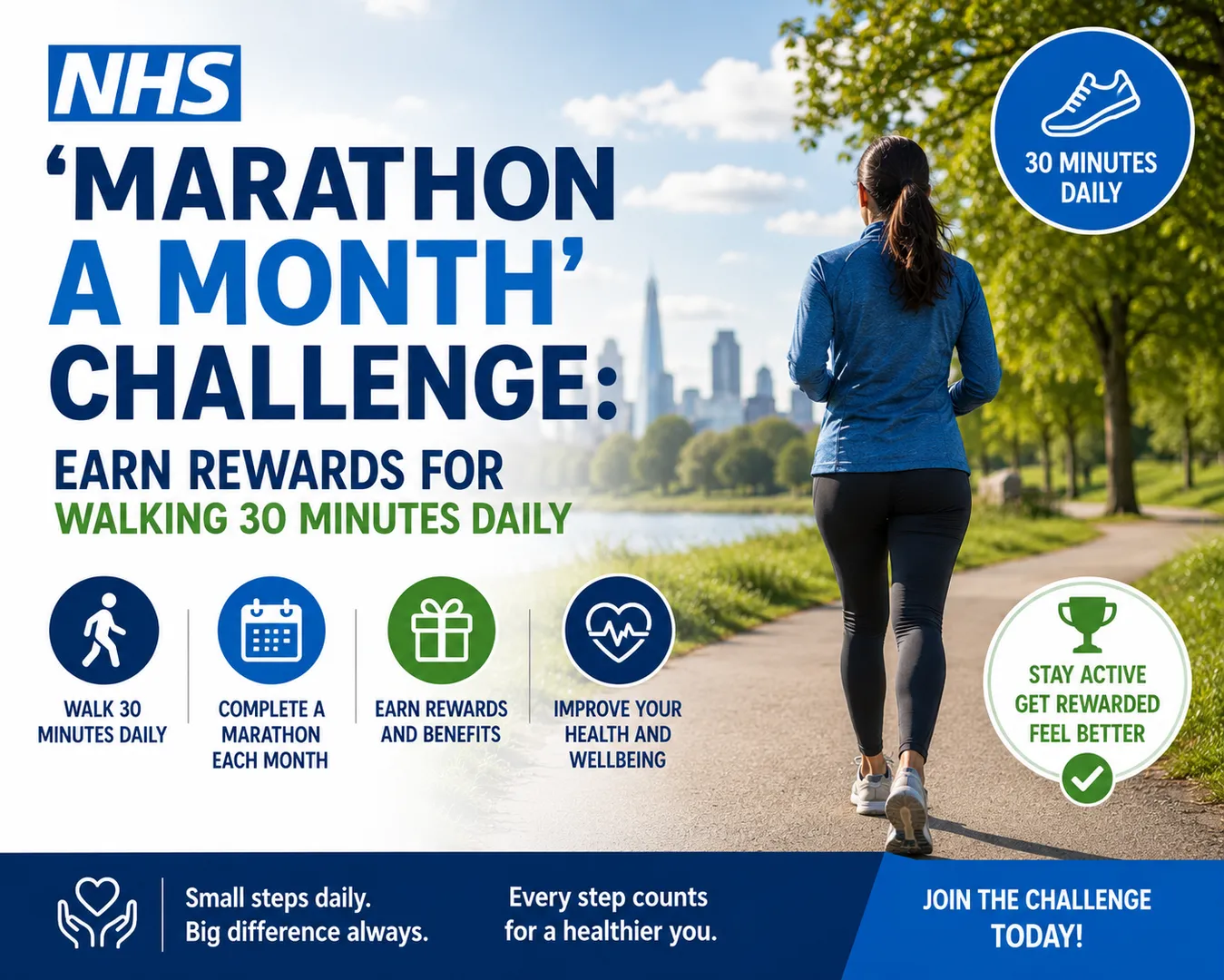
What's the NHS "Marathon a Month" Challenge?
The NHS is launching something genuinely exciting in early 2026 — a nationwide walking challenge called "Marathon a Month". The idea is simple: walk around 30 minutes a day, every day. Do that consistently and by the end of the month you'll have walked roughly 26 miles — the exact distance of a full marathon.
What makes this different from every other "just walk more" campaign you've seen before? For the first time, the NHS will actually reward you for doing it. Complete the challenge and you become eligible for incentives — think discounts, vouchers, and possibly free food or drinks from partner brands.
🎯 The deal: Walk 30 minutes a day. Hit marathon distance every month. Get real rewards. No gym membership. No equipment. Completely free to join.
How Does It Work?
The scheme is built around modern "streak culture" — the same habit-forming psychology that keeps people opening Snapchat every day or hitting their Duolingo lesson for 500 days in a row. If you don't want to break your streak, you're much more likely to stick with it.
You'll be able to log your daily walks in three easy ways:
- Online through a simple website
- Through your smartphone (any phone with step tracking)
- Through your smartwatch — Apple Watch, Fitbit, Samsung Galaxy Watch etc.
Every day counts as a "streak day". Miss a day, and you might lose your streak. Hit 30 minutes daily for a full month, and you unlock rewards.
Who's Behind It?
The scheme has been developed in partnership with Sir Brendan Foster — the Olympic medallist and founder of the Great North Run. NHS England asked him to lead the campaign, and his goal is refreshingly simple.
Another big name involved is Sir Keith Mills — the man who invented Air Miles and the Nectar loyalty scheme. He's helping design the reward system, which tells you the incentives will be properly thought out rather than an afterthought.
Why Is the NHS Doing This?
The numbers are honestly a little worrying. Here's the reality of physical inactivity in the UK today:
| Fact | Number |
|---|---|
| UK deaths linked to physical inactivity | 1 in 6 |
| Adults classified as physically inactive (year to Nov 2025) | ~12 million |
| Percentage of UK adults not moving enough | ~25% |
| Minimum activity needed weekly | 30 minutes |
| Extra healthy years from walking 30 mins, 5 times a week | Up to 4 years |
Nearly a quarter of UK adults — around 12 million people — are classified as physically inactive. That means they do less than 30 minutes of moderate exercise per week. The scheme is part of the wider 10-year health plan for England, and if it works, it could genuinely save the NHS millions of pounds a year in treating preventable illness.
What Are the Rewards?
Full details of the rewards haven't been released yet, but here's what we know so far:
- Vouchers and discounts from partner brands
- Free food or drink offers from partner retailers
- Possible tie-ins with loyalty schemes (given Sir Keith Mills' involvement)
- Recognition for hitting personal milestones
The NHS itself is not funding the rewards. Instead, the NHS is covering the initial set-up, and the actual incentives will be provided by partner organisations from the public and private sector. Big corporations and philanthropic backers are expected to fund the reward pool as the scheme rolls out.
Why 30 Minutes a Day Actually Matters
You might be thinking — 30 minutes of walking? That doesn't sound like much. But the health science is actually really clear.
- Lowers risk of heart disease, stroke, and Type 2 diabetes
- Reduces risk of certain cancers
- Improves mental health and reduces stress
- Helps maintain a healthy weight
- Strengthens bones and muscles
- Improves sleep quality
- Boosts energy levels throughout the day
- Extends healthy life expectancy by up to 4 years (if done 5 times per week)
And here's the best part — you don't even need to do the full 30 minutes in one go. Three separate 10-minute walks throughout the day count just as much as one long walk. That means a walk to the shops, a walk during your lunch break, and a walk to a friend's house could easily add up.
How to Get Ready for the Launch
Sign-up details will be released closer to the launch in early 2026. But there's no reason to wait — you can start building the habit right now so you're ready to go from day one. Here's how:
Start Tracking Your Steps Now
Your phone already tracks steps by default. On iPhone, look for the Health app. On Android, check Google Fit or Samsung Health. You don't need a fancy smartwatch to get started.
Build the 30-Minute Habit Before Sign-Up Opens
Start with just 10 minutes a day for a week. Add another 10 minutes the next week. By the third week, you'll be doing the full 30 without noticing.
Find Your Time Slot
The people most likely to stick with walking are those who tie it to something they already do — walking during a lunch break, walking after dinner, or walking to the school run instead of driving.
Break It Into Smaller Chunks
You don't need to do 30 minutes in one go. Three 10-minute walks throughout the day work exactly the same. Fit them wherever suits your routine.
Watch Out for Sign-Up Details in Early 2026
The NHS will announce full details of how to register in the coming months. We'll keep this article updated as more information is released.
Why This Could Actually Work
Health campaigns telling people to "eat better" and "move more" have been running for decades — and often had very limited impact. What's different here is the psychology. The scheme uses gamification — streaks, rewards, and clear daily goals — the same tools that keep millions of people hooked on apps like Duolingo, Snapchat, and Strava.
And crucially, walking is one of the most accessible forms of exercise. As one of the people the BBC spoke to put it:
No gym fees. No expensive equipment. No specific skill required. Just put your shoes on and step outside. If the NHS can hit its target of 100,000+ people, it would technically be the biggest marathon ever run — one step at a time.
Not Everyone Is Fully Convinced
While the scheme has been broadly welcomed, some health experts have raised valid points. Sonia Pombo, head of research at Action on Salt & Sugar, put it well:
In other words — walking is great, but it can't fix everything on its own. Tackling unhealthy food advertising, sugar in children's diets, and wider social issues around health matters just as much.
Frequently Asked Questions
The scheme is set to launch in early 2026. Full sign-up details, along with the reward system, will be released in the coming months.
Yes. There is no cost to join the scheme. The NHS is covering the initial set-up, and rewards will be provided by partner organisations from the public and private sector.
No. You'll be able to log your walks online, through your phone (which already tracks steps by default), or through any smartwatch. A smartwatch is not required.
Yes. Three 10-minute walks throughout the day count exactly the same as one 30-minute walk. This is one of the reasons the scheme is expected to be so accessible.
Yes. You'll simply log your walks like everyone else and become eligible for rewards once you hit the monthly target. As one interviewee put it — he'd happily take a free reward for something he's already doing.
Full details haven't been announced yet, but rewards are likely to include vouchers, discounts, and free food or drink offers from partner brands. Given the involvement of Sir Keith Mills (the man behind Air Miles and Nectar), the reward system is expected to be well thought out.
We Are Here to Help
Planning to Explore the UK?
From visa consultation and business setup to understanding how UK systems work — Rohit Kamboj Tracker is here to help. Book a consultation today and get clear, reliable guidance from day one.
📅 Book a Consultation