What's actually being announced
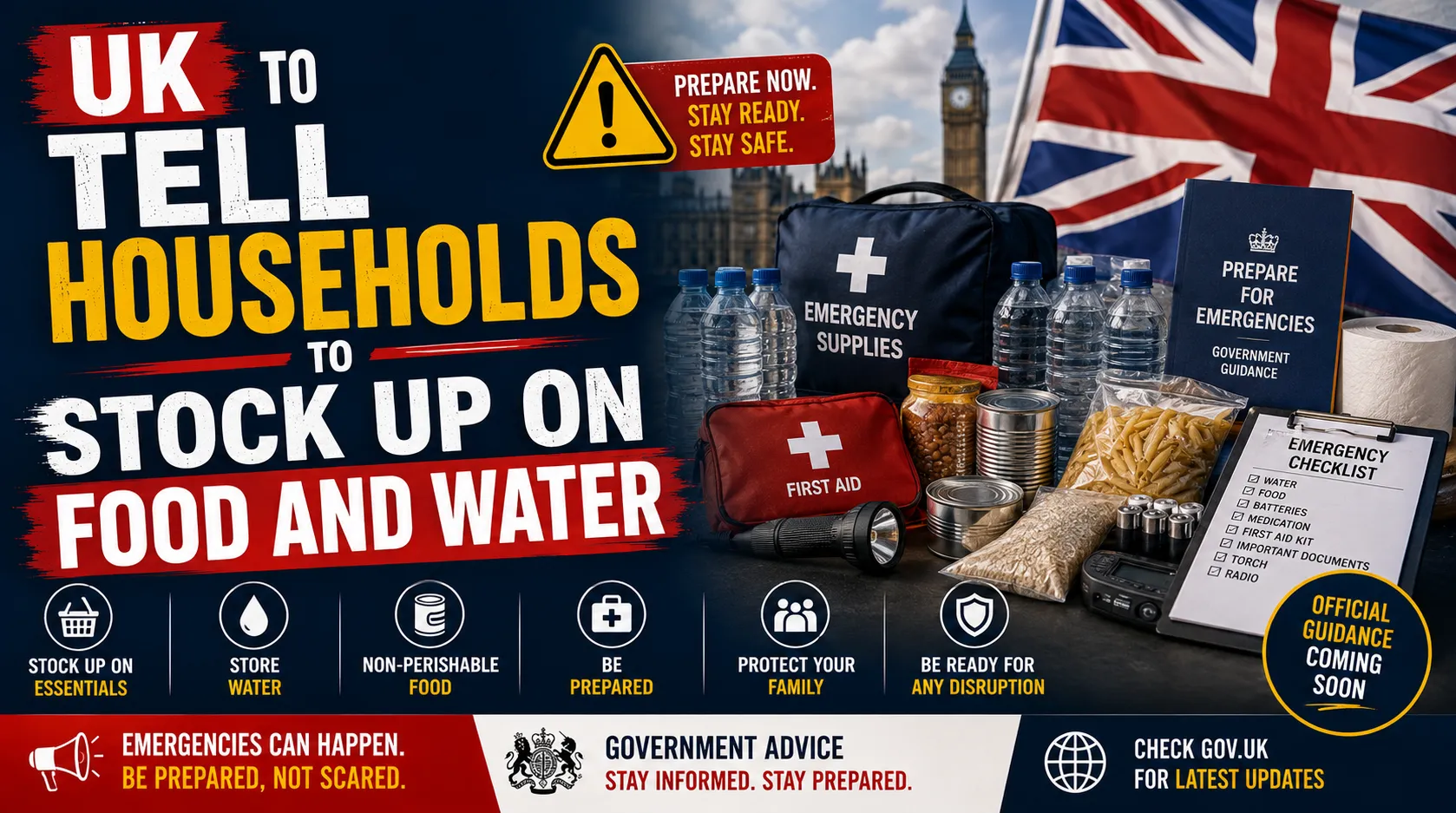
The Cabinet Office is developing a national public information campaign that will encourage UK households to keep basic supplies at home — think tinned food, bottled water, and other essentials — in case normal services are disrupted. The government first confirmed the campaign was coming on 14 July 2026, as part of its 2026 Resilience Action Plan, though it initially gave no firm launch date beyond "later this year."
The story picked up pace in late August, when the Guardian reported more detail on what the advice will actually cover: practical, simple steps rather than instructions to build large stockpiles. As of now, the government still hasn't published a confirmed launch date or the full campaign material.
Why now — two reasons, not one
The campaign is being framed around two connected risks, not a single scare:
🌡️ Climate-related disruption
- UK heatwaves, wildfire warnings, and drought conditions this year
- An emergency wildfire phone alert was sent to millions of Britons recently
- Flooding and extreme heat can disrupt electricity, water, and transport
🛰️ Hostile-state and cyber threats
- Cyberattacks on data, water, and police infrastructure are a growing concern
- The government is reassessing preparedness for a hostile-state military threat
- Officials have referenced the risk of "hybrid attacks" as part of the justification
What the government is actually saying
Ministers have been careful to frame this as common sense rather than alarm. A Cabinet Office spokesperson told the Guardian: "Safeguarding national security is the first priority of any government. We're committed to raising awareness of simple steps households can take to make themselves more resilient, as well as driving forward the home defence programme to build our country's preparedness for various threats."
The underlying logic is straightforward: if most households already have basic supplies and a rough plan for coping without power, water, or internet for a few days, the government can direct emergency resources toward the people who genuinely can't manage alone — the elderly, disabled, or otherwise vulnerable.
🏡 Why this matters if you've recently moved to the UK
If you're new to the UK, this kind of household-preparedness messaging can feel unfamiliar — it isn't something every country does. It's worth taking seriously without overreacting: this is standard resilience planning, not a sign of an impending crisis.
What this means for you, practically
-
Don't panic buy
There's no shortage and no active emergency. Building supplies gradually over a few weeks is more than enough — there's no need to empty supermarket shelves in one trip.
-
Aim for a 3-day buffer
This is the benchmark UK ministers have referenced previously — enough tinned food, bottled water, and any essential medicines to get through 72 hours without leaving home.
-
Think beyond food
Torches, a wind-up or battery radio, a portable phone charger, and candles have all been mentioned by ministers as part of general "personal resilience."
-
Check on relatives
If you have family in the UK, it's worth checking they could manage a few days without normal services, and agreeing how you'd stay in contact if communications were disrupted.
-
Watch for the official campaign
Once launched, the detailed guidance will be published on gov.uk's prepare pages — that will be the authoritative source rather than news coverage or social media.
💡 Useful to know
This isn't entirely new territory. UK ministers have floated similar "prepare for 3 days" advice before, and many local councils already run yearly resilience campaigns (such as "30 Days, 30 Ways" each September). This national campaign builds on that existing approach rather than introducing something from scratch.
Useful links
The Guardian — Original Report
Read →
GOV.UK — Prepare for Emergencies
Visit →
Frequently asked questions
Is this an emergency warning?+
No. There is currently no active emergency and no instruction to panic buy. This is a forthcoming public information campaign, not a response to an immediate threat.
When does the campaign launch?+
No firm date has been confirmed yet. The Cabinet Office said on 14 July 2026 that it would launch "later this year," and as of the most recent reporting, a specific date still hasn't been published.
How much food and water should I keep at home?+
Ministers have previously referenced a 3-day supply as a sensible benchmark — enough tinned food, bottled water, and essential medicines to manage without leaving home or relying on power for 72 hours.
Is this only about extreme weather?+
No — the campaign explicitly covers two risk categories: climate-related disruption (heatwaves, wildfires, flooding) and hostile-state or cyber threats that could disrupt electricity, water, or communications.
Where can I get the official guidance once it's out?+
The gov.uk/prepare pages will host the official campaign material once launched — that's the most reliable source, rather than news coverage or social media summaries.
#UKNews
#LifeInTheUK
#UKResilience
#EmergencyPreparedness
#CabinetOffice