

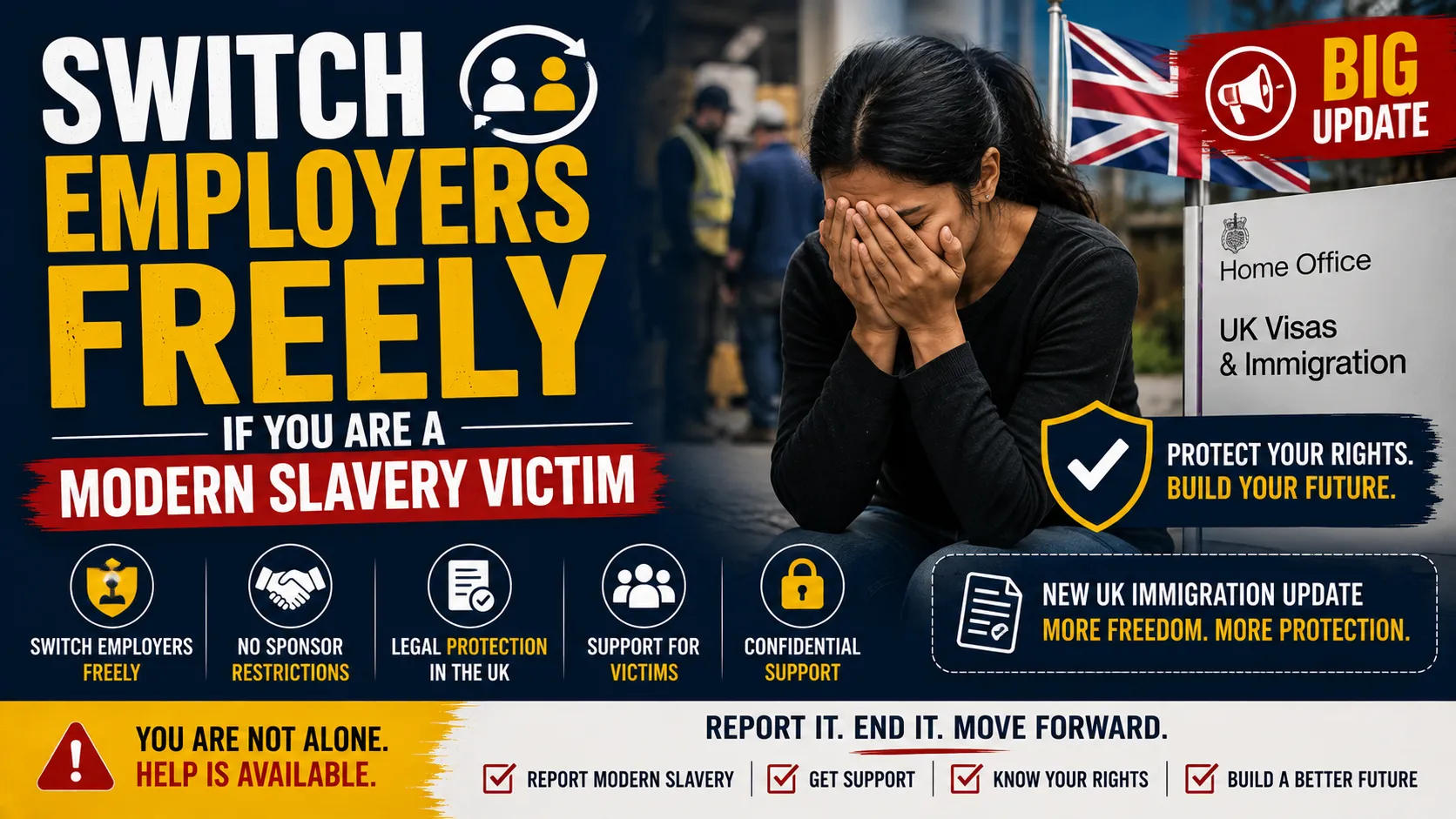
Switch Employers Freely if You Are a Modern Slavery Victim — Big Update
Your visa no longer has to stay tied to the employer who exploited you
I've had clients sit across from me and describe genuinely frightening working conditions, then ask the same question: "If I leave, do I lose my visa?" Until now, my honest answer was — possibly, yes. That's the part that's finally changing.
The problem this actually solves
A Skilled Worker visa has always been tied to one specific job, with one specific sponsor. Step outside that job — even because you were forced to — and your legal right to stay in the UK could unravel with it. I've seen how that trap gets used. Someone with a genuine grievance stays quiet, because reporting it feels riskier than enduring it.
The government's own explanatory memorandum puts it plainly: this change lifts that restriction specifically for workers identified by the Home Office's Competent Authorities as victims of modern slavery, letting them work for any employer, for the remaining duration of their existing permission — no new sponsor, no new Certificate of Sponsorship, no fresh application.
❌ How it worked until now
- One sponsor, one job — leave, and status is at risk
- New employer meant a fresh CoS and a fresh application
- Reporting abuse could feel like reporting yourself
- Many stayed in bad jobs simply to stay legal
✅ How it works from 8 Oct 2026
- Recognised victims can walk away from the sponsor
- Free to work any job, for any employer, immediately
- Status holds for the rest of the original visa
- Coming forward no longer means starting over
Who this actually covers
This isn't a general "my job is bad" clause. The trigger is formal: recognition as a victim of modern slavery by the Home Office's Competent Authorities, which in practice means going through the National Referral Mechanism (NRM) and receiving a positive conclusive grounds decision. That's the line between a difficult workplace and a legally recognised case of exploitation.
Worth knowing the scale of this: Home Office figures show 23,411 potential victims were referred through the NRM in 2025 alone — up 22% on 2024, the highest total since the NRM began. Labour exploitation made up a large share of those. This rule change isn't reacting to a handful of cases — it's responding to a system under real, growing pressure.
Why the date matters more than the headline
Here's something worth being precise about, because I've seen the announcement misread already: the Home Office's public statement said the protection applies "from today" — 3 September 2026. But the actual Statement of Changes (HC 584) sets the legal commencement date at 8 October 2026. Until then, the existing rules still apply. If you're relying on this for a real decision, work off 8 October, not the announcement date.
If you think this applies to you
-
Don't quit first, ask first
Resigning before you understand how it interacts with your status can create a gap you didn't need to create.
-
Write down what's happened
Dates, hours, unpaid wages, threats, confiscated documents — whatever you can evidence, even informally, strengthens an NRM referral.
-
Get an honest read on your case
Not every difficult job meets the modern slavery threshold. An adviser can tell you early whether NRM referral is realistic.
-
Plan around 8 October
If your case is strong but not urgent, timing your referral around the commencement date matters.
-
Get your new status in writing
Once recognised, get clear written confirmation of exactly what work you're permitted to take on, and until when.
If you're a sponsor, read this differently
The other side of this announcement is enforcement. The government has been explicit that sponsors found to have exploited workers face the full weight of the law, including police referral where there's evidence of criminality. If you hold a licence, this is a reasonable moment to look honestly at your own recruitment, pay records, and working hours — before someone else does.
Frequently asked questions
Does this apply from 3 September or 8 October?
The Home Office announced the policy on 3 September 2026, but the legal change itself — under Statement of Changes HC 584 — commences on 8 October 2026. Treat 8 October as the operative date.
Does leaving a difficult job automatically qualify me?
No. You need formal recognition as a victim of modern slavery by the Home Office's Competent Authorities, via a positive conclusive grounds decision through the NRM — not just a bad working experience.
Can I switch to a completely unrelated occupation?
Yes — once recognised, you can work for any employer in any occupation for the rest of your existing visa's validity, with no new sponsor required.
Is the process guidance available yet?
Not yet. The Home Office has said guidance will be published once the Rules take effect on 8 October 2026, to avoid people relying on an outdated version in the meantime.
1:1 Call with Rohit Kamboj
Book a call and I'll share what I've learned — plus the practical guidance my team provides every day at Visa Tracker. For personalised immigration advice, you'll be connected with our partnered UK-registered immigration lawyers.
🏛️ Book a Consultation